Published by the Democratique Socks design team on January 1, 2026.
Durable Socks for Men – The Complete Quality Guide (2026 Edition)
Quick Answer
Durable socks for men are made with high-density knitting, long fiber cotton, reinforced heel and toe areas, and balanced elastic recovery. Cheap socks wear out quickly because they use short cotton fibers and low needle construction.
Durability is not about thickness.
Durability is about construction.
Why Do Socks Wear Out?
Most socks fail because of friction and fiber fatigue.
The most common damage areas are:
-
Heel
-
Toe
-
Ball of foot
-
Cuff
When cotton fibers are short, they break faster.
When the knit is loose, friction destroys the structure.
When elastic is weak, the sock loses shape.
A durable sock must be engineered to resist friction.
See our durable socks HERE.

What Makes Socks Durable?
There are five critical construction elements.
1. High Needle Count Knitting
High needle count means the sock is knitted with more needles per cylinder.
Example: 200 needle construction.
Benefits:
-
Tighter fabric
-
Higher density
-
Better resistance to thinning
-
Longer lifespan
-
Improved shape retention
Low needle count socks feel soft at first, but they lose structure quickly.
High density knit socks maintain integrity over time.
2. Long Fiber Cotton (Combed Cotton)
Cotton fiber length matters.
Short fibers:
-
Break easily
-
Create pilling
-
Lose strength
Long fibers:
-
Create stronger yarn
-
Improve durability
-
Increase smoothness
-
Reduce weak points
Combed cotton removes short fibers and aligns long fibers.
Organic combed cotton adds environmental responsibility.
3. Reinforced Heel and Toe
Heel and toe areas experience the most pressure.
Reinforcement means:
-
Extra yarn density
-
Stronger knit tension
-
Improved abrasion resistance
Without reinforcement, holes appear quickly.
Durable socks always reinforce high-friction zones.
4. Balanced Elastic Recovery
Elastic fibers must:
-
Stretch comfortably
-
Return to original shape
-
Maintain tension after washing
If elastic fails:
-
Socks slide down
-
Fabric collapses
-
Fit becomes unstable
Elastic recovery is critical for long-term structure.
5. Rib Construction vs Flat Knit
Rib construction creates vertical elasticity.
Benefits of rib:
-
Better structure
-
Improved recovery
-
Reduced slippage
-
Longer shape stability
Flat knit stretches horizontally and loses strength faster.
Rib knit maintains alignment and durability.
Why Thickness Does Not Equal Durability
Many people believe thick socks last longer.
This is incorrect.
Durability depends on:
-
Fiber quality
-
Knit density
-
Reinforcement
-
Elastic balance
A thin high-density sock can outlast a thick low-density sock.
How Long Should Durable Socks Last?
With normal rotation and correct washing:
-
For years with proper care
-
100+ wash cycles
-
No holes at heel or toe
-
No significant thinning
-
No loss of shape
If socks fail within months, construction quality was low.
Signs of Low Quality Socks
You can identify weak socks by:
-
Early pilling
-
Fabric thinning after 10–20 washes
-
Loose cuff
-
Twisted shape after drying
-
Heel losing definition
These are indicators of low needle count and short fiber cotton.
Why German Customers Search for “Langlebige Socken”
In Germany, customers often search for:
-
langlebige Socken Herren
-
hochwertige Socken Herren
-
Socken die nicht rutschen
-
haltbare Socken
-
Bio Baumwolle Socken
These search terms focus on durability and quality.
This guide addresses exactly those criteria.
Durable Socks for Sneakers
Sneakers increase friction because:
-
The heel moves constantly
-
The foot flexes repeatedly
-
The interior creates pressure
Durable sneaker socks require:
-
Reinforced heel
-
Dense knit
-
Strong cuff structure
-
Breathable cotton
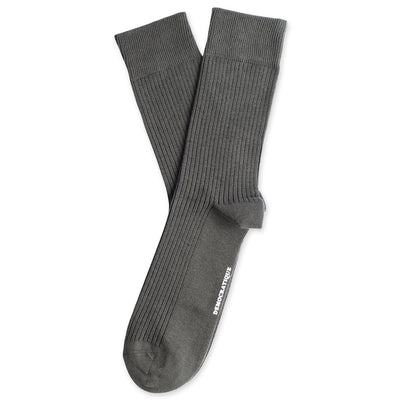
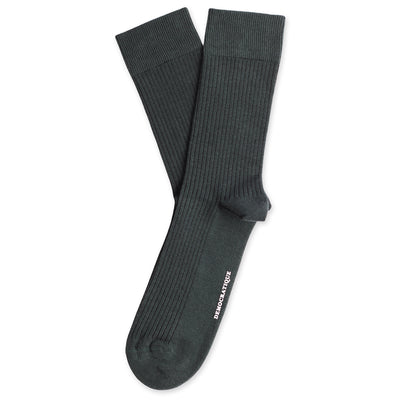
Fine rib crew socks are especially effective for sneakers.
Durable Socks for Office and Daily Wear
Daily wear requires:
-
Structure without bulk
-
Breathability
-
Consistent fit
-
Long-term stability
High-density rib socks provide everyday durability without excessive thickness.
Sustainable and Durable
True sustainability combines:
-
Organic cotton
-
Long product lifespan
-
Reduced replacement frequency
-
Responsible production
A sock worn for years is more sustainable than a cheap sock replaced every year.
Durability reduces waste.
Care Guide for Longer Lifespan
To extend durability:
-
Wash at 30–40°C
-
Avoid high heat drying
-
Do not use fabric softener
-
Turn socks inside out before washing
Heat and chemicals damage fibers and elastic.
Correct care preserves structure.
Durable Socks vs Cheap Bulk Socks
Cheap socks:
-
Lower needle count
-
Mixed short fibers
-
Minimal reinforcement
-
Weak elastic
-
Short lifespan
Durable socks:
-
High needle construction
-
Long fiber cotton
-
Reinforced zones
-
Stable elastic recovery
-
Multi-year lifespan
Long-term cost is lower with quality socks.
Why Scandinavian Design Focuses on Construction
Scandinavian design prioritizes:
-
Longevity
-
Material honesty
-
Functional minimalism
-
Clean aesthetics
A premium sock is not decorative.
It is engineered for everyday use.
FAQ
What are the most durable socks for men?
High-density knit socks made from combed cotton with reinforced heel and toe areas.
Are rib socks more durable?
Yes. Rib construction maintains structure and improves long-term shape retention.
Do organic cotton socks last longer?
When combined with dense knitting and reinforcement, organic combed cotton improves durability.
Why do socks get holes at the heel?
Because of friction and insufficient reinforcement.
How many socks should a man own?
A practical rotation includes 7–14 pairs to reduce wear frequency.
Final Conclusion
Durable socks are defined by construction, not marketing.
Look for:
-
200 needle knitting
-
Combed long fiber cotton
-
Reinforced heel and toe
-
Stable elastic recovery
-
Rib structure
When these elements are present, socks remain durable, form stable, and comfortable for years.
Choose structure.
Choose longevity.
Choose engineered essentials.