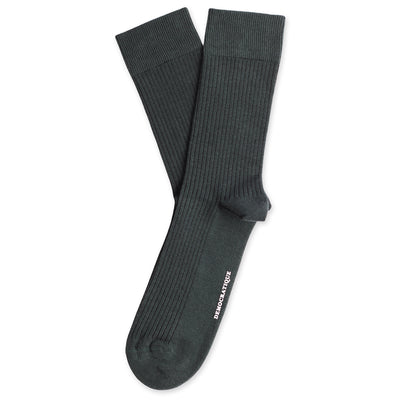
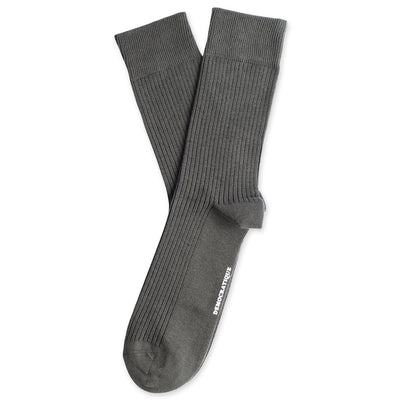
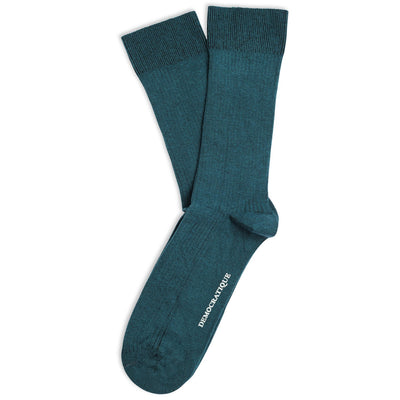
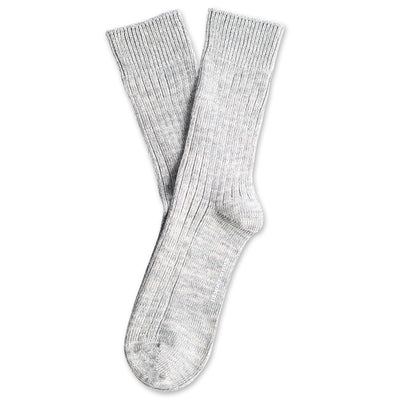
Published by the Democratique Socks design team on August 9, 2026.
The toe seam is where most mass-market socks fail. It is the last step in sock production — closing the open end of the sock tube after knitting — and it is the step where manufacturers most frequently cut cost. The result is a raised ridge across the top of the foot that is barely noticeable in thick socks and immediately apparent in finer ones. In dress shoes and fitted footwear, that ridge creates pressure that compounds through hours of wear.
The hand-linked toe is the alternative. Every sock in the Democratique range carries one. This is what it is, how it is made, and why it matters. For the full picture on premium sock construction, see Why 200-Needle Socks Are Better, What Is Combed Cotton? and Are Expensive Socks Worth It?
How a standard machine toe seam is made
After knitting, the sock tube is open at the toe end. In standard production, this is closed by a looper machine that folds the toe flat and runs a seam across it. The process takes seconds per pair and requires no skilled labour. The seam is visible on the outside of the sock as a ridge, and palpable on the inside as a raised line across the top of the foot.
The ridge is minor in thick socks — the surrounding fabric is substantial enough to distribute the pressure. In a fine-knit sock at 200 needles, where the fabric is thin and close to the foot, the ridge sits directly against the skin and creates a friction point that worsens over a full day of wear.
How a hand-linked toe seam is made
In hand-linking, each loop of the toe opening is placed by hand onto a circular linking machine, one loop at a time, so that each stitch on the sock corresponds exactly to a stitch on the linker. The machine then closes the toe by joining loop to loop, producing a seam that is virtually flat — no ridge on the inside or outside.
The process requires a skilled operator and takes significantly longer per pair than machine looping. At Democratique's factory in Istanbul — one of the world's finest sock factories, the same production partner since 2011 — every pair in the range is hand-linked as a baseline construction standard, not a premium tier option.

Why it matters
The practical difference is comfort across a full day of wear. In dress shoes, the toe seam of a machine-finished sock creates a pressure point at the junction of the upper and the sock. This is minimal in the first hours and increases as the day progresses. The hand-linked toe eliminates the ridge entirely — the foot sits against a flat, smooth surface from first wear to last. See the full guide to best socks for dress shoes and what socks to wear with a suit.
The second benefit is durability. A hand-linked toe distributes tension evenly across the closure because each loop is individually aligned. A machine seam concentrates stress at the overlocked edge. Over repeated washing and wearing, the hand-linked toe holds its integrity longer. See How Long Do Quality Socks Actually Last?
The third benefit is appearance. From outside the sock, a hand-linked toe is virtually invisible — the toe closes flush with the surrounding fabric. A machine seam is visible as a slight ridge or colour variation at the toe.
How to identify a hand-linked toe
Turn the sock inside out and run your finger across the toe seam. A machine seam has a raised edge you can feel clearly. A hand-linked seam is nearly flat — you can feel the join but not a ridge. From the outside, look at the toe: a hand-linked closure has a neat, barely visible line.
Why most brands don't do it
Cost and time. Hand-linking requires skilled operators and adds meaningful time per pair. For a mass-market brand producing millions of units, the economics are impossible. For a brand producing at the quality level Democratique operates at — 200-needle organic combed cotton, one factory partnership since 2011 — it is a baseline construction standard.
Browse the full range: Originals Fine Rib, Athletique Classique, Relax Collection. OEKO-TEX Standard 100 certified. Organic combed cotton since 2020. Designed in Copenhagen since 2011. EU 36–46.