By the Democratique Socks design team · Updated October 25, 2026
Short answer: A 200-needle sock is knitted on a machine with 200 needles around its cylinder, so every round of the sock has 200 stitches instead of the 100–140 used for most everyday socks. More, smaller stitches give a denser, smoother and more even fabric that holds its shape better, feels finer against the skin and sits flatter inside a shoe. It is one of the clearest technical markers of a premium dress sock — but only when it is paired with good yarn and careful finishing.
Pick up two plain black socks in a shop and they look almost identical. Pull them over your hand, hold them up to a window, and the difference appears: one is a fine, even mesh; the other lets the light through in a coarse grid. Most of that difference comes down to a single number that almost never appears on the packaging — the needle count.
What does "needle count" actually mean?
Socks are made on small circular knitting machines. At the heart of each machine is a steel cylinder lined with tiny latch needles standing side by side. As the cylinder turns, every needle catches the yarn and pulls it through the previous loop, forming one stitch. One full rotation produces one round — a "course" — of the sock.
The needle count is simply how many needles sit around that cylinder. A 200-needle machine creates 200 stitches in every round. Because a man's sock has roughly the same circumference whatever machine it is made on, more needles means each stitch has to be smaller. That is why needle count works as a shorthand for how fine and dense a knit is.
Typical needle counts and what they are used for
| Needle count | Typical use | How the fabric feels |
|---|---|---|
| 84–108 | Chunky, cushioned and outdoor socks | Thick, soft, visibly textured |
| 120–144 | Most everyday and multipack socks | Standard weight, open knit when stretched |
| 168 | Better dress socks | Finer, smoother, lighter |
| 200 | Premium dress and everyday socks | Dense, smooth, even, close to a fine-gauge knit |
The ranges are indicative: manufacturers combine needle counts with different cylinder sizes and yarn thicknesses. But as a rule of thumb, the jump from a standard 120-needle sock to a 200-needle sock means roughly 65% more stitches in every round.
Why 200 needles makes a better sock
1. A smoother feel against the skin
Smaller stitches create a flatter surface with fewer ridges and gaps. On the foot that reads as smoothness — the sock feels closer to a fine knitwear fabric than to a sports sock. It also sits flatter inside a leather shoe, where a bulky knit can rub.
2. A denser fabric that holds its shape
More stitches per centimetre means more yarn holding the structure together. A dense knit is less prone to the slow sagging, bagging at the ankle and thinning at the heel that make cheaper socks look tired after a few months. The more stitches share the load, the less any single one has to stretch.
3. Better fit and recovery
Fine-gauge knitting lets a rib pattern be tighter and more regular. Combined with a small share of polyamide and elastane, the sock follows the shape of the foot and calf and springs back after washing instead of slowly losing its grip and sliding down.
4. Cleaner colour and a more refined look
A dense surface reflects light more evenly, so colours look deeper and more uniform — particularly noticeable in navy, bordeaux and black. When the sock shows between trouser hem and shoe, that evenness is exactly what separates a considered sock from an afterthought.
Needle count is not the whole story
A high needle count is necessary for a premium dress sock, but it is not sufficient. Three other things decide whether a 200-needle sock is actually good:
- The yarn. A fine knit needs a fine, strong yarn. Combed cotton has had its short, weak fibres removed, leaving longer fibres that pill less and stay smooth. Read more about combed cotton.
- The toe seam. Many socks are closed with a quick machine overlock that leaves a hard ridge across the toes. A hand-linked toe seam joins the toe loop by loop, so it lies flat.
- The finishing. Washing and steaming the finished socks sets the fabric and its size before they reach you, so the fit you get on day one is the fit you keep.
When 200 needles is the wrong choice
Finer is not automatically better for every situation. Thick hiking socks, chunky winter socks and heavily cushioned sport socks are deliberately knitted on fewer needles with heavier yarn: the goal there is warmth, padding and bulk, not a fine surface. A 200-needle sock is the right tool for leather shoes, loafers, tailoring and everyday sneakers — situations where you want a thin, smooth, durable layer that looks good when it shows.
How to tell a fine-knit sock without a label
- The light test. Stretch the sock gently over your hand and hold it towards a window. A fine knit stays almost opaque; a coarse one turns into a visible grid.
- Count the ribs. On a ribbed sock, more and narrower ribs across the leg usually mean a higher needle count.
- Feel the inside. Turn the sock inside out. A fine knit feels flat and even; a coarse one feels loopy.
- Check the toe. Run a finger across the toe seam. A flat, almost invisible join is a sign that the rest of the sock was made with the same care.
How Democratique Socks are made
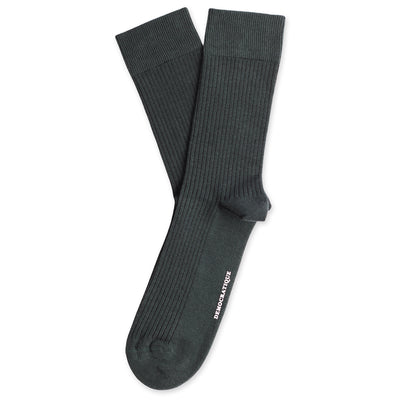
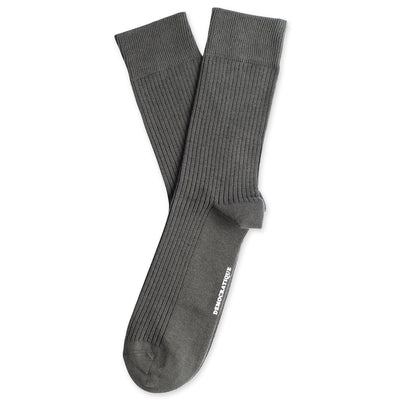
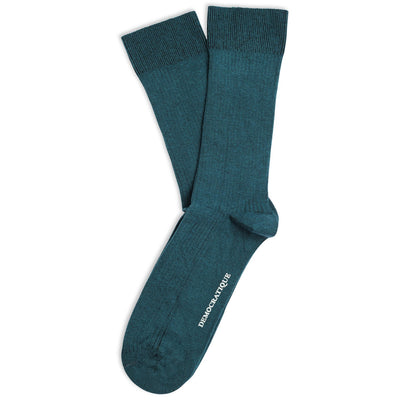
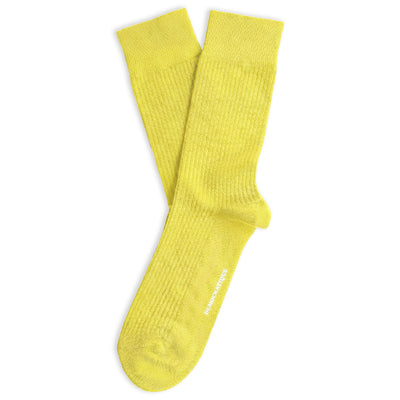
Our Originals Fine Rib socks are knitted on 200-needle machines in Istanbul from 75% organic combed cotton, with 23% polyamide and 2% elastane for strength and recovery. Every pair has a hand-linked toe seam, is washed and steamed before packing, and is certified to OEKO-TEX Standard 100 — the dyes included. We have designed them in Copenhagen since 2011, in solid colours that are made to be worn every day, not saved for special occasions.
That combination — fine needles, good yarn, a flat seam and proper finishing — is why a pair holds its shape, colour and fit for years of regular wear and washing.

Frequently asked questions
What does 200 needles mean in socks?
It means the sock was knitted on a circular machine with 200 needles, so each round of the sock contains 200 stitches. The higher the count, the smaller and denser the stitches — which gives a smoother, finer and more even fabric.
Are 200-needle socks better than 144-needle socks?
For dress socks and everyday wear with shoes, yes: a 200-needle sock has roughly 40% more stitches per round than a 144-needle sock, so it is denser, smoother and holds its shape better. For thick, cushioned or outdoor socks a lower needle count with heavier yarn is the better choice.
Do 200-needle socks last longer?
A denser knit spreads wear across more stitches, so it resists thinning and losing shape better than a coarse knit made from the same yarn. How long a sock lasts in practice also depends on the yarn quality, the toe seam and how it is washed — 200 needles combined with combed cotton and a hand-linked toe is what makes a sock last for years.
Are 200-needle socks thinner?
They are usually finer rather than thinner. Because the stitches are small and tightly packed, a 200-needle sock can feel light and smooth while still being dense and opaque — the opposite of a cheap thin sock, which is thin because it is loosely knitted.
Are 200-needle socks warm enough for winter?
Yes for everyday wear with shoes and boots: a dense cotton knit insulates well and breathes. For very cold conditions or long days outdoors, a chunky, heavier sock knitted on fewer needles gives more warmth.
How can I see the needle count of a sock?
Most brands do not print it. Premium brands that use 200-needle machines usually state it in the product description. Without a label, the light test, the rib count and the feel of the inside are the most reliable clues.
Related reading: The best socks for men in 2026 – complete buying guide · What is combed cotton? · Hand-linked toe seams explained